I Couldn’t Read My Index Cards!
Then They Introduced Me.
A few weeks ago, I gave a keynote speech in Florence for a new company.
It was in Italian.
Now, I speak Italian fluently. I work in Italian. I lead trainings in Italian. I’ve lived in Italy for 20 years.
Italian is not my mother tongue. Even when you are incredibly fluent, doing a speech or an important presentation in front of a large group in a language that is not your mother tongue is always intimidating. At the very least, it makes you self-conscious of any error you might make and be judged upon.
So although I felt about 95% memorized, I had a safety net: professional index cards with the outline of the speech printed on them. Just in case.
On the morning of the keynote, I did everything I tell other speakers to do.
I warmed up my voice. I did my breathing exercises to calm my nervous system. When waiting, in the audience, for my turn to speak, I sat in a power pose— an open, grounded posture—to tell my brain, YOU CAN DO THIS!
Then they introduced me. I walked onto the stage. And discovered one tiny problem.
I couldn’t read my notes!!!
The lights in the room were much dimmer than I had expected. And at 47, while my eyesight is perfectly good at a distance, close-up reading has become another story.
I needed my reading glasses. My reading glasses were not with me.
Because, naturally, I had never once thought: What if I need reading glasses onstage?
DAMN AGING!
So there I was. Onstage. In front of a room full of people. Giving a keynote in my second language. With index cards I could barely read.
And this is where my PREPARATION kicked in. Preparation creates confidence.
One of the ideas at the heart of my keynote was that confidence is something you can learn to communicate through your mind, body, and voice, no matter your mood, life pressures, or emotional state.
But there’s another piece I would add: Confidence is also built through preparation.
Actors understand this instinctively.
We don’t rehearse a scene once and then hope inspiration strikes on opening night.
We say the words out loud. We get on our feet. We repeat the words over and over.
We discover where to breathe, where to move, where to pause, where the thought changes.
Eventually, the words stop living on paper or at the tip of your tongue. Your body begins to know them too.
That is exactly how I had rehearsed this keynote. Not silently at my desk. But out loud.
Wherever I was, which in this case, was a SAILBOAT! Again and again and again.
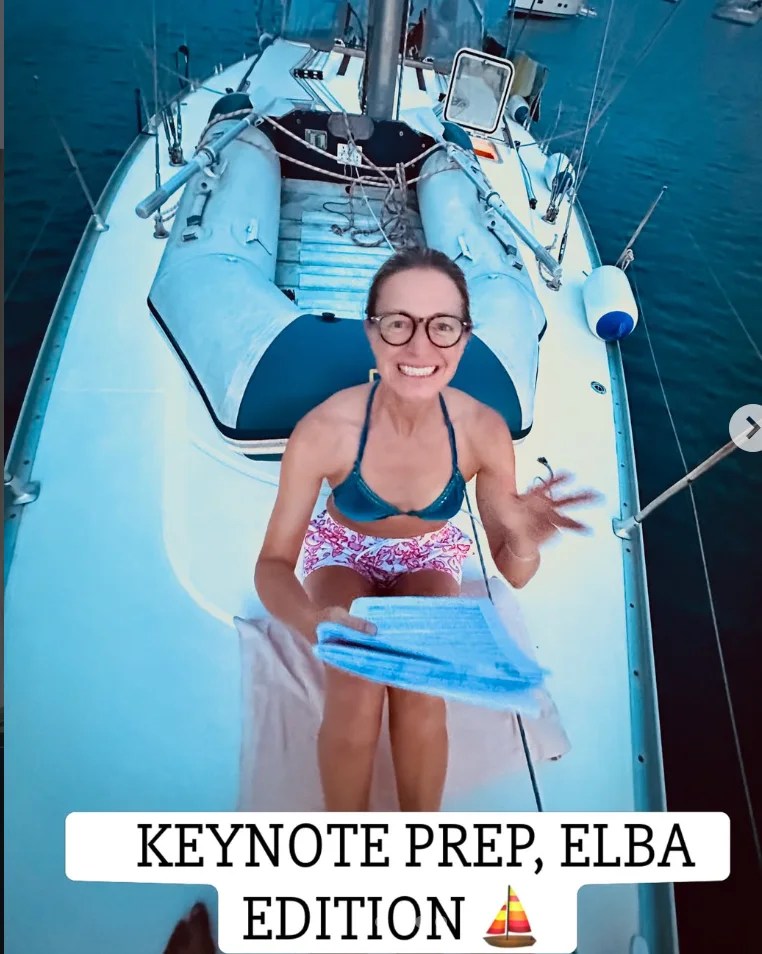
So when, on that stage, I realized my safety net was suddenly not very safe,I had a choice: Panic.
Or trust the work I had already done.
I trusted the work.
THE TRICKS OF THE TRADE
Memorize the beginning
You MUST know the first few minutes of your speech exceptionally well.
Why?
Because at the beginning of a speech, your job isn’t remembering every brilliant sentence you wrote.
It’s connecting with the audience. Look at them. Let them look at you. Breathe.
Smile. Be present. Make them feel that you are talking to them, not reciting something at them. Connection buys you an enormous amount of goodwill and empathy.
If the audience feels connected to you and you later stumble over a word, forget a sentence or need a second to find your place, they are happy to forgive and forget OR they don’t even notice at all. They want you to succeed!
And because I knew those opening minutes cold, I could walk onto that stage without immediately worrying about my cards.
15 Minutes into my speech, I forgot a transition.
My mind suddenly went: What comes next?
Nothing.
I could not remember.
This is another thing acting teaches you: Don’t advertise the mistake.
The audience doesn’t have your script! They don’t know what you were supposed to say next!
So I stopped. I looked down. I let my eyes focus. I found the next few words on the card.
And I remembered! That was it. No panic. No apology. No “Sorry, I lost my place.” Just: find the thought and keep going.
Over the entire keynote, I looked at those cards only three times.
Everything else was there.
Because I had prepared.
TEDx spotlight
Have you watched my TEDx talk yet?
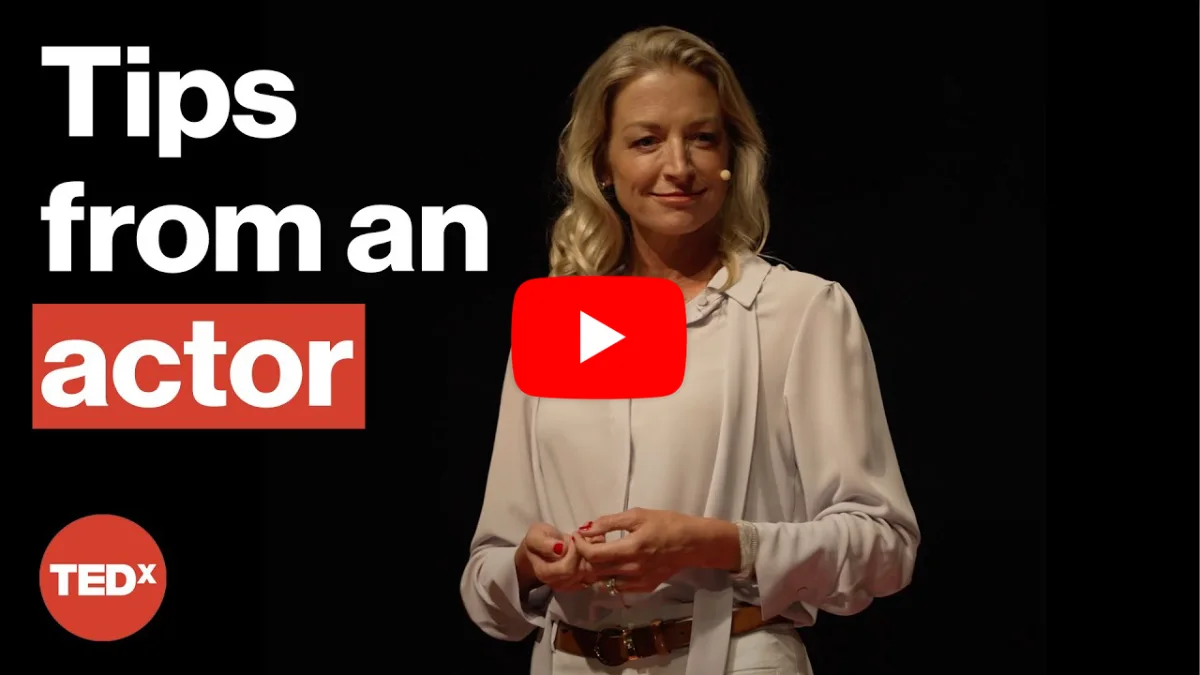
If you are thinking about your presence, your voice or how you communicate under pressure, my TEDx talk offers a useful starting point.
It is a reflection on the stories we tell ourselves, the messages we communicate to others, and what becomes possible when we allow ourselves to be more fully seen and heard.

SUMMER MUSINGS WHILE I HAVE HAD MORE TIME TO THINK ABOUT ME
(and not only my fabulous clients, kids and hubbie)
The summer is over. The kids are back in school. I’m getting back into the swing of things. But I’m not there yet. My mind is still in vacation mode, which really means reflection mode.
One theme that I became slightly obsessed with this summer was the idea of longevity.
You might make an immediate connection between my need for reading glasses during the (above) keynote speech and longevity, and you are not wrong.
And yet, I am not at all interested in longevity from the wellness-trend point of view. I couldn’t care less about longevity IV’s, expensive peptides, and tons of plastic surgery to make me look younger. I’m talking about how to age with a functional mind, an agile body, a dose of humility and a few doses of “umph” to keep me living with positive energy into what Italians call “la terza età” (the third age).
“La terza età” refers to older adulthood– from active retirement to more advanced old age.
What I see around me, from both my American parents and my Italian in-laws, are 75–85-year-olds who are aging in varying degrees of health, agility, and enjoyment of life. Some of the success in aging clearly depends on the cards you’ve been dealt. Getting slapped with a Parkinson’s or cancer diagnosis can obviously derail your well-deserved and long-earned retirement plans.
But it’s also blatantly obvious to me that there are other things that steer one’s path towards a healthy and happy third age. My father goes to the gym 4-5 days a week and does a moderate, balanced, full-body workout. He also takes daily walks and rarely complains of depression or lack of energy. Sure, he has body aches and brain gaps. Yet he keeps living, travels, and is fun. He stays socially and mentally engaged.
Two older people in our families have both been dealt with real diseases, and who, also, in the years leading up to their diseases, exercised little if at all. One reads books, which is great for the mind. One spends a lot of time on her cell phone and iPad. They mention depression and have both gotten sick and seem much older, slower, and are more dependent on others.
Is it a coincidence? I don’t know. It is EASY to watch from the outside and judge and make assumptions, and I do not want to do that.
What I DO know is that I am currently OBSESSED AND DETERMINED, in as much as is possible based on the cards that I am given, to arrive at my third age with spiritual energy, mental resilience and physical agility.
So what did I do this summer while at the seaside for our annual August beach month? I worked out often, read as much as possible, took a lot of naps, studied new trends in public speaking and communication, and was social with new people.
I’ve decided I’d like to find a tap-dance class so that I can do something for ME that brings me pure joy and some good physical challenges.
I’m curious where you are all at regarding this.
How are you dealing with growing older and with longevity?!
Here is to returning not with pressure to be perfect, but with the willingness to prepare, practise and begin again.
With gratitude,
Elia
Communicate the best of yourself.
PS – If this info was helpful, please pass it on to someone else who could find it beneficial!